
Stamped Concrete Installation in Redwood City, CA
Redwood City Concrete Solutions designs and installs stamped concrete surfaces for homeowners throughout Redwood City and the greater San Mateo County area.
20+
Years of Experience
525+
Projects Completed
5.0 ★
Google Rating
The Look of Natural Stone, the Strength of Concrete
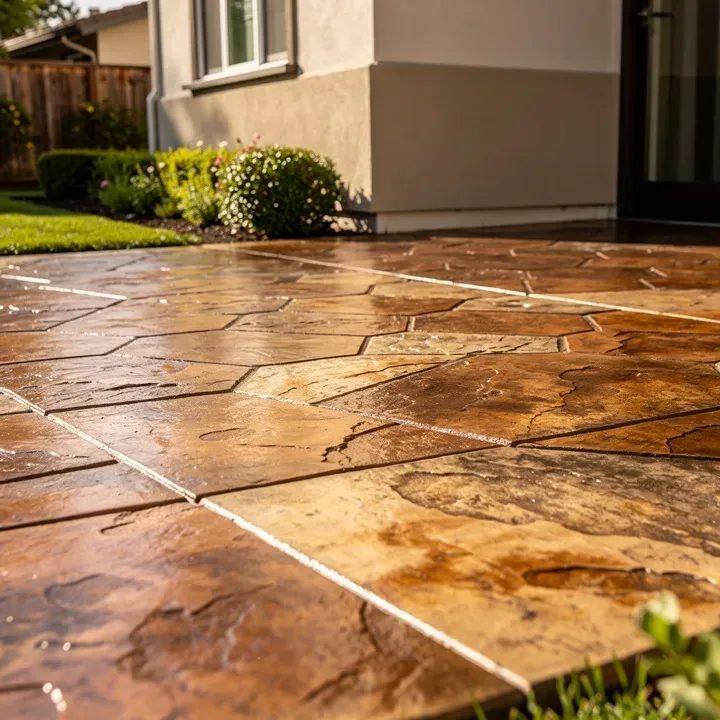
Stamped concrete gives homeowners the ability to achieve the high-end appearance of natural stone, brick, slate, or tile without the cost, maintenance challenges, or long-term durability concerns that come with those materials. The pattern is pressed directly into the concrete surface while it is still workable, and color is added through integral pigments, surface hardeners, or release agents that create depth and variation in the finished appearance.
The result is a surface that looks genuinely premium, holds up to decades of use, and requires far less ongoing maintenance than the natural materials it resembles. There are no individual pavers to shift, no grout joints to re-point, no stone surfaces to seal annually. You get the aesthetic you want with the practicality of concrete underneath it.
Stamped concrete is versatile enough to work in almost any outdoor application. It is a popular choice for patios, pool decks, driveways, walkways, and courtyards. Whether you want a rustic flagstone look, a refined large-format tile pattern, or something in between, the range of available stamps and color combinations is wide enough to match virtually any architectural style or personal preference.
Is Stamped Concrete the Right Choice for Your Project?
Stamped concrete tends to appeal most to homeowners who want their outdoor surfaces to make a strong visual impression without committing to the cost and complexity of natural stone or clay brick. It is particularly well suited to patio and pool deck applications where the surface is a focal point of the outdoor living area and appearance matters as much as function.
It is also a practical upgrade for homeowners who are already planning to replace an existing concrete surface. Adding a stamped finish to a new pour costs a fraction of what natural stone or pavers would cost for the same area, and the finished result is often indistinguishable from the real thing at a glance.
That said, stamped concrete does require some additional care compared to plain concrete. The surface should be sealed periodically to protect the color and finish from UV exposure, staining, and surface wear. In high-traffic areas, the sealant may need to be reapplied every two to three years to keep the surface looking its best. This is a straightforward maintenance task, but it is worth understanding upfront so you can plan for it.
Homeowners considering stamped concrete near a pool should also know that the texture and finish of the stamp pattern plays an important role in traction. We always select or recommend finishes that provide reliable grip when wet, so safety is not compromised in exchange for aesthetics.
How Stamped Concrete Is Installed: The Full Process
Stamped concrete installation begins well before the first bag of cement is mixed. The design process is where we work with you to select the stamp pattern, color palette, and border details that match your vision for the space. These decisions need to be locked in before the pour because the stamping and coloring happens while the concrete is still in a workable state. Changes cannot be made after the fact, so we take the time upfront to make sure you are fully confident in the selections before we begin.
Once the design is confirmed, we prepare the site the same way we would for any concrete project. The area is excavated to the correct depth, the sub-base is compacted thoroughly, and the forms are set with the correct slope and dimensions. For larger or more complex layouts, we may install additional reinforcement such as rebar or wire mesh to add structural integrity to the finished slab.
The concrete is poured and screeded to a consistent level across the entire area. Color hardener or integral color is applied at this stage depending on the chosen coloring method. As the concrete reaches the right consistency, the stamp mats are pressed firmly and evenly across the surface in a carefully sequenced pattern to ensure the design aligns correctly and the texture is consistent throughout. Borders and accent details are hand-tooled where needed.
Once the stamping is complete and the concrete has cured to the appropriate strength, a release agent residue is cleaned from the surface and a high-quality sealant is applied. The sealant protects the color, enhances the depth of the finish, and provides a degree of water resistance. We walk you through the aftercare requirements before leaving the site so you know exactly how to maintain the surface going forward.
What Drives the Cost of a Stamped Concrete Project
Stamped concrete costs more than plain concrete, and understanding why helps you evaluate whether the investment is right for your project. The additional cost comes from several sources: the stamp mats and coloring materials themselves, the additional skill and labor required to apply the pattern consistently across a large surface, and the sealing step that is built into every stamped concrete installation.
The size of the area is the primary cost driver. Larger surfaces require more material, more time, and more care in keeping the pattern aligned across the full extent of the pour. Complex layouts with multiple pattern areas, color combinations, or decorative borders require more planning and execution time and are priced accordingly.
The pattern and color choices you make also affect the final cost. Standard single-color applications with a straightforward stamp pattern are at the lower end of the stamped concrete price range. Multi-tone color blending, intricate border details, or custom pattern combinations that require more specialized stamp mats and additional handwork are at the higher end.
Finally, site conditions play a role. If the existing surface needs to be demolished and removed, if the base requires significant preparation work, or if access to the area is restricted, these factors add to the overall scope and cost of the project. We cover every one of these elements in detail during the free estimate so you walk away with a complete and accurate understanding of what the project will cost and what is included.
Frequently Asked Questions
How does stamped concrete compare to pavers in terms of cost and durability?
Stamped concrete is generally less expensive than pavers for the same surface area, primarily because pavers require individual placement, more complex base preparation, and more labor time to install. From a durability standpoint, a properly installed stamped concrete slab is a single continuous surface with no joints for weeds to grow through and no individual units to shift or sink over time. Pavers can be easier to repair in isolated spots, but stamped concrete holds up very well when installed correctly and maintained with periodic resealing.
Will the color fade over time?
All colored concrete will experience some degree of color change over time due to UV exposure and normal wear. The rate of fading depends on the coloring method used, the quality of the sealant, and how consistently the surface is resealed over the years. A high-quality sealant applied at installation and reapplied every two to three years will significantly slow the fading process and keep the surface looking close to its original appearance for many years. We use quality materials and walk you through the maintenance schedule before we finish the job.
Can stamped concrete be repaired if it cracks?
Hairline cracks can develop in any concrete surface over time, including stamped concrete. Minor cracks can be filled and sealed in a way that is reasonably unobtrusive, though matching the color and pattern exactly in a repair is difficult. This is why proper installation matters so much: a well-prepared base, correct slab thickness, and properly placed control joints significantly reduce the likelihood of cracking occurring in the first place. We build these best practices into every stamped concrete project we take on.
How long does a stamped concrete installation take?
The pour and stamping phase of most residential projects is completed in a single day. However, the concrete needs adequate curing time before the sealant can be applied, which typically means returning to the site one to two days after the pour to complete the sealing step. The full project from start to finish, including site preparation, is usually wrapped up within two to three days depending on the size and complexity of the layout. We give you a clear schedule before work begins so you can plan around it.
Ready to Get Started? Let's Talk About Your Project.
Whether you have a cracked driveway that needs attention, a patio you have been wanting to upgrade, or a larger concrete project you are not sure how to approach, we are here to help. Contact Redwood City Concrete Solutions today for a free, no-obligation estimate. We will come out, take a look, and give you a straight answer about what your property needs and what it will cost. No pressure, no runaround. Just honest advice from a local concrete contractor you can trust. Call us or send a message and we will get back to you promptly.


Contact
(650) 995-5358
Mon–Sun: 7am–7pm
Redwood City, CA
About Us
Redwood City Concrete Solutions is a locally owned concrete contractor with over 20 years of experience serving homeowners throughout Redwood City and the greater San Mateo County area. We are known on the Peninsula for honest work, quality results, and showing up when we say we will. We serve Redwood City and surrounding communities including San Carlos, Belmont, San Mateo, Menlo Park, Atherton, and Palo Alto.
© Copyright 2026 Redwood City Concrete Solutions. All rights reserved.
© Copyright 2026 Redwood City Concrete Solutions.
All rights reserved.