
Concrete Block Wall Installation in Redwood City, CA
Redwood City Concrete Solutions builds concrete block walls for homeowners throughout Redwood City and the greater San Mateo County area.
20+
Years of Experience
525+
Projects Completed
5.0 ★
Google Rating
Built to Define, Protect, and Last for Decades
A concrete block wall is one of the most durable and low-maintenance boundary solutions available to residential property owners. Unlike wood fencing, it does not rot, warp, or require periodic painting or staining to maintain its appearance and structural integrity. Unlike ornamental iron, it does not rust and does not need to be treated or recoated over the years. Once a concrete block wall is properly built, it simply stands and does its job without demanding anything from you.
The practical benefits go beyond durability. A solid concrete block wall provides genuine privacy in a way that most other fencing options cannot match. It significantly reduces noise transmission from neighboring properties or nearby streets, which matters more than most homeowners expect until they experience it firsthand. It creates a clear, permanent property boundary that eliminates ambiguity and disputes with neighbors. And it adds a sense of structure and enclosure to a backyard that can make the outdoor space feel more intentional and usable.
Concrete block walls are also highly versatile from a design standpoint. Standard gray block is the most economical option and suits a wide range of residential settings. Slump block, split face block, and other textured finishes offer a more distinctive appearance for homeowners who want the wall to complement the architectural character of the home rather than simply blend into the background. Cap blocks and pilasters can be added to give the wall a more finished, architectural look at relatively modest additional cost.
When Is a Concrete Block Wall the Right Choice?
Homeowners come to us for block wall projects in a variety of situations. Some are replacing an old wood fence that has finally reached the end of its life and want something that will not need to be replaced again. Some are dealing with a crumbling or leaning existing block wall that was poorly built or has been undermined by root intrusion or soil movement over the years. Others are adding a new wall where none currently exists, either to establish a property boundary, create privacy in a backyard, or retain a sloped section of land.
Retaining walls represent a specific and important application for concrete block construction. On properties where the yard has a significant slope, a properly engineered retaining wall holds back the soil and prevents erosion, creating level usable areas in spaces that would otherwise be difficult or impossible to use. A retaining wall that fails can cause significant damage to the surrounding landscape, to structures nearby, and in serious cases to neighboring properties. This is not a project where cutting corners on design or construction is ever a good idea.
Choosing not to address a failing or inadequate block wall can create problems that extend well beyond the wall itself. A leaning or cracked wall that is not stabilized will eventually fall, and when it does, the damage it causes, whether to landscaping, vehicles, structures, or neighboring property, is far more expensive to deal with than the cost of a properly executed repair or replacement. We assess every wall situation honestly and tell you clearly whether repair is the right path or whether replacement is the more practical long-term solution.
How We Build a Concrete Block Wall
Every block wall project begins with a site visit to assess the location, the purpose of the wall, the soil conditions, and any slope or drainage factors that need to be accounted for in the design. For straightforward boundary walls on level ground, the process is relatively uncomplicated. For retaining walls or walls on sloped sites, the design phase is more involved and may require engineering input to ensure the wall is sized and reinforced correctly for the loads it will need to resist.
Once the design and layout are confirmed, we excavate for the footing. The footing is the concrete base that the block wall sits on, and it is what gives the wall its long-term stability. A block wall without an adequate footing, or one poured on poorly prepared ground, is a wall that will shift, crack, and lean over time regardless of how well the blocks above it are laid. We do not skip or rush this step.
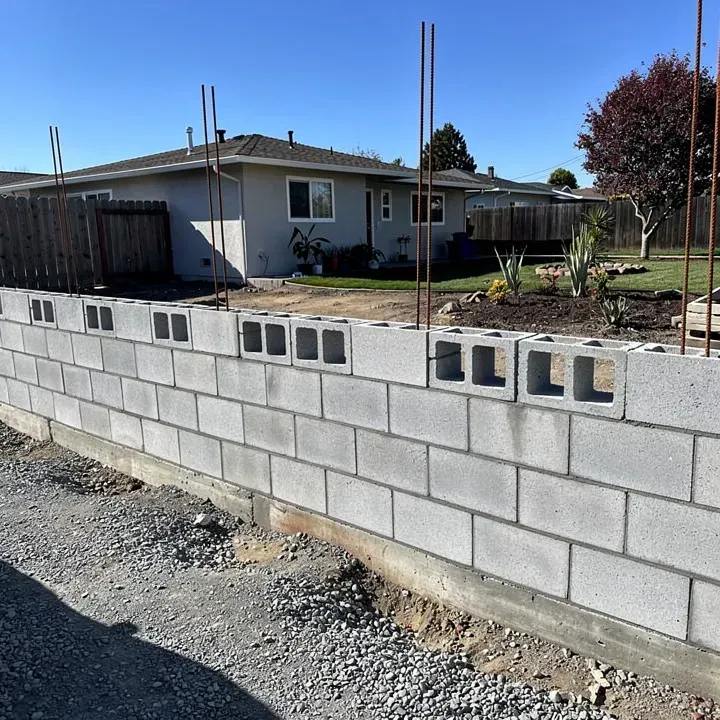
After the footing has cured to sufficient strength, we begin laying the block courses. Each course is leveled carefully and checked for plumb throughout the construction process. Vertical cores in the block are filled with grout and reinforced with rebar at the intervals specified by the design, which ties the wall together structurally and significantly increases its resistance to lateral forces. For taller walls or retaining applications, the reinforcement schedule is more intensive and is designed to handle the specific loads the wall will experience.
Cap blocks are installed along the top course to give the wall a clean, finished appearance and to protect the cores of the blocks below from water intrusion. If pilasters, gates, or decorative elements are part of the design, these are built in at the appropriate stages of construction rather than added as an afterthought. The finished wall is cleaned down and the surrounding area is restored before we consider the project complete.
Understanding Block Wall Pricing
The cost of a concrete block wall is driven primarily by its length and height. Longer and taller walls require more block, more mortar, more grout, more rebar, and more labor time to build. A short garden wall along one side of a backyard is a very different scope from a full perimeter boundary wall enclosing a large property, and the pricing reflects that difference directly.
The type of block selected affects the material cost. Standard gray concrete masonry units are the most cost-effective option. Specialty finishes such as split face, slump block, or architectural block cost more per unit but can significantly improve the visual quality of the finished wall, particularly on properties where the wall is highly visible from the street or from living areas of the home.
Footing requirements add to the overall cost of any block wall project. Walls on sites with poor soil conditions, significant slope, or high moisture levels need more substantial footings to perform reliably over time. Retaining walls have their own cost structure that reflects the engineering requirements and the additional reinforcement needed to safely hold back soil loads. We cover all of these factors in detail during the estimate so you have a complete and accurate picture before committing to the project.
Demolition and removal of an existing wall, if one is being replaced, also adds to the overall scope. Old block walls often need to be broken up and hauled away before the new footing can be poured, and the condition of the existing footing determines whether it can be reused or needs to be replaced entirely. We assess all of this during the site visit and include it transparently in the written estimate.
Frequently Asked Questions
Do I need a permit to build a block wall on my property in Redwood City?
It depends on the height and location of the wall. In Redwood City, walls above a certain height, typically six feet, generally require a building permit. Retaining walls are almost always subject to permit requirements regardless of height due to their structural nature. Walls along property lines may also be subject to setback requirements. We are familiar with the local requirements and will confirm what is needed for your specific project during the site visit so there are no surprises after the work begins.
How long does a concrete block wall last?
A properly built concrete block wall with an adequate footing and correct reinforcement can last 50 years or more with minimal maintenance. The main threats to long-term performance are water intrusion through unsealed caps or cracked mortar joints, root intrusion from nearby trees, and inadequate original construction. Keeping mortar joints in good condition and ensuring the wall caps are intact goes a long way toward protecting the investment for decades.
Can a leaning or cracked block wall be repaired rather than replaced?
Sometimes yes, but it depends entirely on what caused the movement in the first place. A wall that is leaning due to root intrusion or soil erosion at the footing level generally cannot be stabilized by repairing the wall surface alone. The underlying cause needs to be addressed, and in many cases that means rebuilding from the footing up. A wall with isolated cracked or spalled blocks and intact mortar joints may be repairable without full replacement. We assess every situation on-site and give you an honest recommendation based on what we find.
What is the difference between a boundary wall and a retaining wall?
A boundary wall sits on level or near-level ground and serves primarily to define a property line, provide privacy, or act as a visual barrier. It carries its own weight and resists wind loads but is not designed to hold back significant volumes of soil. A retaining wall is built specifically to resist the lateral pressure of soil on one side, which is a fundamentally different structural challenge. Retaining walls require more substantial footings, heavier reinforcement, and in many cases drainage provisions behind the wall to prevent hydrostatic pressure from building up. The design and cost of the two types of walls reflect this difference.
Ready to Get Started? Let's Talk About Your Project.
Whether you have a cracked driveway that needs attention, a patio you have been wanting to upgrade, or a larger concrete project you are not sure how to approach, we are here to help. Contact Redwood City Concrete Solutions today for a free, no-obligation estimate. We will come out, take a look, and give you a straight answer about what your property needs and what it will cost. No pressure, no runaround. Just honest advice from a local concrete contractor you can trust. Call us or send a message and we will get back to you promptly.


Contact
(650) 995-5358
Mon–Sun: 7am–7pm
Redwood City, CA
About Us
Redwood City Concrete Solutions is a locally owned concrete contractor with over 20 years of experience serving homeowners throughout Redwood City and the greater San Mateo County area. We are known on the Peninsula for honest work, quality results, and showing up when we say we will. We serve Redwood City and surrounding communities including San Carlos, Belmont, San Mateo, Menlo Park, Atherton, and Palo Alto.
© Copyright 2026 Redwood City Concrete Solutions. All rights reserved.
© Copyright 2026 Redwood City Concrete Solutions.
All rights reserved.