
Concrete Patio Installation in Redwood City, CA
Redwood City Concrete Solutions designs and installs concrete patios for homeowners throughout Redwood City and the greater San Mateo County area.
20+
Years of Experience
525+
Projects Completed
5.0 ★
Google Rating
Low Maintenance, Long Lasting, and Worth Every Penny
When you invest in a concrete patio, you are adding a surface that will still be performing well 30 years from now with very little effort on your part. There is no staining, no sealing, no replacing rotted boards, and no re-leveling shifted pavers every few seasons. You pour it once, finish it right, and it holds up through everything the Bay Area climate throws at it without asking much in return.
Beyond durability, a concrete patio gives you genuinely usable outdoor space. The Peninsula enjoys a climate that makes outdoor living realistic for a significant portion of the year, and having a clean, level, solid surface to take advantage of that makes a real difference in how much you actually use your backyard. Whether you are setting up a permanent outdoor dining area, creating a safe surface for children to play on, adding space for entertaining, or simply want somewhere comfortable to sit outside in the evening without dealing with uneven ground or muddy patches, a well-built concrete patio delivers all of that without ongoing hassle or recurring maintenance costs.
It is also worth considering the long-term value a concrete patio adds to the property. Outdoor living space is consistently valued by homebuyers, and a clean, well-finished patio makes a strong impression during a sale. Unlike a wood deck that a buyer might see as a future maintenance liability, a concrete patio is something most buyers view as an asset that requires nothing from them going forward.
Does Your Current Patio Need to Go?
Many homeowners across Redwood City and the surrounding Peninsula communities are living with a patio that has quietly become more of a problem than an amenity. Cracking is the most visible sign, and it tends to progress faster than most homeowners expect once it starts. A hairline crack that appears after the first wet season can widen significantly over the following years as water penetrates, erodes the base material underneath, and the slab begins to move unevenly. What looked like a cosmetic issue becomes a structural one.
Uneven or sunken sections are another common complaint. When the sub-base beneath a patio slab erodes or was never properly compacted in the first place, sections of the slab begin to sink or tilt. The resulting raised edges and uneven transitions are a genuine trip hazard, particularly for older family members or young children who use the space regularly. In a backyard setting where people are often moving around without paying close attention to the ground underfoot, this is not a risk worth accepting.
Beyond safety, a patio that looks worn, stained, or structurally compromised affects the overall feel of the outdoor space. Most homeowners with a deteriorating patio find themselves using the backyard less, simply because the surface does not invite them to spend time on it. The backyard becomes somewhere to walk through rather than somewhere to be, and that represents a real loss of usable living space in a region where property is valuable and outdoor space should be enjoyed.
A patio that drains incorrectly is a further concern that goes beyond surface-level deterioration. If the slab has shifted to a negative slope that directs water back toward the house, that water is working against your foundation every time it rains. Addressing a deteriorating patio is in many cases also an opportunity to correct drainage problems that are silently contributing to a much more serious issue below ground.
From Ground Prep to Final Finish: Our Process
Every patio project we take on starts with a thorough site assessment. We look at the existing conditions, discuss the size and layout you have in mind, and work through any drainage considerations that need to be factored into the design before a single form is set. Getting the slope right from the start is one of the most important parts of a patio installation: the finished surface needs to move water away from the house and toward appropriate drainage points, not pool in the middle or drain back toward the foundation.
Once the design is confirmed and all details are agreed upon, we excavate the area to the correct depth. If there is existing concrete to remove, we demolish and haul it away cleanly before beginning base preparation. The sub-base is graded and compacted thoroughly. This step is one that less careful contractors rush or skip entirely, and it is one of the primary reasons patios fail ahead of schedule. A slab is only as stable as what sits beneath it, and we take the time to get the base right because everything we pour on top of it depends on it.
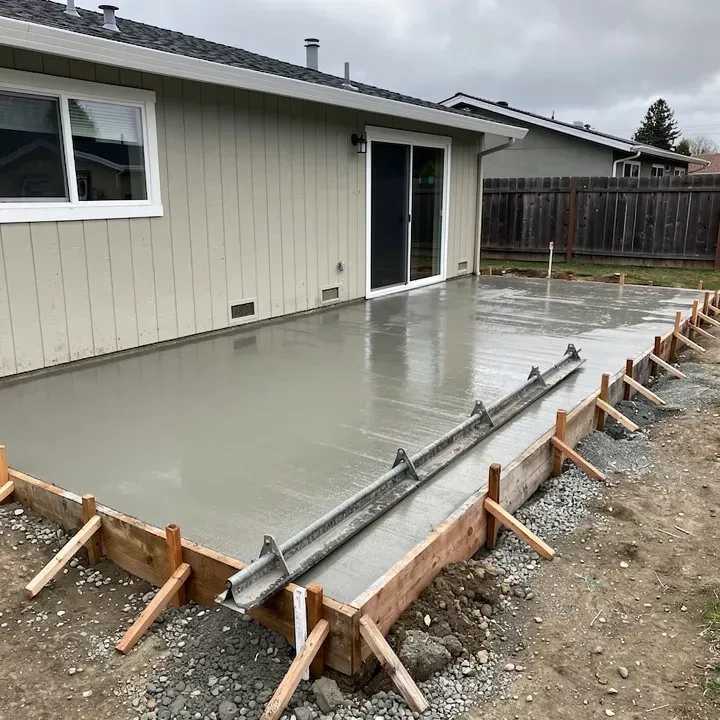
With the base prepared, we set the forms to the agreed dimensions and slope. The concrete is poured and screeded to a consistent thickness throughout the slab. Finishing options are always discussed and confirmed well before the pour, because the chosen finish affects how and when certain steps are executed. A standard broom finish is applied after screeding to provide good traction and a clean, uniform appearance. For homeowners who want a more distinctive surface, exposed aggregate involves seeding the surface with decorative stone and removing the top layer of cement paste to expose it, while stamped finishes involve pressing pattern mats into the concrete while it is still workable to replicate the appearance of stone, brick, or tile.
Control joints are cut into the slab at the correct intervals to manage the natural movement and shrinkage that occurs as concrete cures and ages. Properly placed control joints guide any cracking that does occur into predetermined lines rather than allowing it to travel randomly across the surface. The finished slab is then cured correctly before the area is handed back to you, and we walk you through the aftercare steps before leaving the site so you know exactly what to do and what to avoid during the curing period.
Understanding the Cost of a New Patio
Patio pricing starts with size. The larger the surface area, the more excavation, base material, concrete, and labor time the project requires. This is the most straightforward cost variable and the one that has the biggest impact on the overall number. Shape adds nuance to that calculation: a simple rectangular layout is easier and faster to form and pour than a curved or irregular design, which requires more time and precision in the forming stage and may involve additional handwork in the finishing phase.
The finish you select is the next significant cost factor. A standard broom finish is the most cost-effective option and is entirely appropriate for most residential applications. Exposed aggregate adds to the cost through the additional material and labor involved in seeding and washing the surface. Stamped concrete involves stamp mats, coloring materials, release agents, and the additional skill required to apply a consistent pattern across a large surface, and is priced accordingly. For homeowners who are considering a decorative finish, we provide clear samples and a transparent breakdown of the cost difference so the decision can be made with full information rather than guesswork.
Site conditions play a meaningful role in the final price as well. If the ground requires significant excavation or regrading before the base can be prepared, that adds to the scope. If there is existing concrete to demolish and remove, that is additional work that factors into the estimate. Properties where backyard access is restricted, either by a narrow side gate or by landscaping that limits equipment access, require more manual labor and take longer to complete. We identify all of these factors during the site visit and include them in the written estimate so the number you receive reflects the actual scope of your specific project rather than a generic per-square-foot figure that may not apply to your situation.
Frequently Asked Questions
Can I add a stamped or decorative finish to a new patio?
Absolutely. Stamped concrete is one of the most popular upgrades we offer on patio projects. It allows you to achieve the look of natural stone, brick, or tile at a lower cost than the real materials, with the durability and low maintenance of concrete. The stamping and coloring is done during the pour while the concrete is still workable, so it needs to be decided and confirmed before the project begins rather than added afterward.
Do you handle patio projects of all sizes?
Yes. We work on everything from small backyard patio additions to large entertaining areas. Whether you are replacing a worn-out slab or starting from scratch in a space that has never had a patio, we size the project to what you actually need and give you a quote that reflects that scope accurately.
How long before I can use my new patio?
Light foot traffic is generally safe after 24 to 48 hours. We recommend waiting at least a week before placing heavy furniture or planters on the surface, and avoiding anything that concentrates significant weight on a single point for the first 28 days while the concrete continues to reach full strength. We will walk you through the aftercare steps before we leave.
How thick should a concrete patio be?
For most residential patios, a thickness of four inches is standard and sufficient for foot traffic and typical outdoor furniture. If you plan to park a vehicle on the surface or use heavy outdoor equipment, we recommend going to five or six inches. We factor this into the estimate based on how you intend to use the space.
Ready to Get Started? Let's Talk About Your Project.
Whether you have a cracked driveway that needs attention, a patio you have been wanting to upgrade, or a larger concrete project you are not sure how to approach, we are here to help. Contact Redwood City Concrete Solutions today for a free, no-obligation estimate. We will come out, take a look, and give you a straight answer about what your property needs and what it will cost. No pressure, no runaround. Just honest advice from a local concrete contractor you can trust. Call us or send a message and we will get back to you promptly.


Contact
(650) 995-5358
Mon–Sun: 7am–7pm
Redwood City, CA
About Us
Redwood City Concrete Solutions is a locally owned concrete contractor with over 20 years of experience serving homeowners throughout Redwood City and the greater San Mateo County area. We are known on the Peninsula for honest work, quality results, and showing up when we say we will. We serve Redwood City and surrounding communities including San Carlos, Belmont, San Mateo, Menlo Park, Atherton, and Palo Alto.
© Copyright 2026 Redwood City Concrete Solutions. All rights reserved.
© Copyright 2026 Redwood City Concrete Solutions.
All rights reserved.